A second life for retail.
Reimagine vacant malls and large anchor stores as productive, welcoming destinations.
The investment thesis
Turning underused properties into places that grow affordable fresh food, creates next generation jobs, supports local businesses and stronger communities.
The Mall Farm & Marketplace proposes turning underused buildings into places for vertical farming, local food sales and community services. Our model connects affordable fresh food with renewable energy, local enterprise and neighborhood renewal.
Vibrant murals celebrate what we grow—and the communities we grow with. Explore three visions for turning familiar buildings into welcoming neighborhood landmarks.
Architectural concepts for future Mall Farm locations. Select any mural for a closer look.
Our vision brings food production, neighborhood commerce and community services together under one development strategy.
Reimagine vacant malls and large anchor stores as productive, welcoming destinations.
The investment thesisUse vertical hydroponics and controlled growing environments to bring production closer to the people it serves.
Inside the growing processMake room for small businesses, job training, food access, arts and everyday connection.
Explore the community vision THE MARKETPLACE · CONCEPT
Imagine picking up locally grown produce, meeting a neighborhood business owner and finding a training program—all in one place.
A year-round marketplace is the social and commercial heart of the Mall Farm vision.
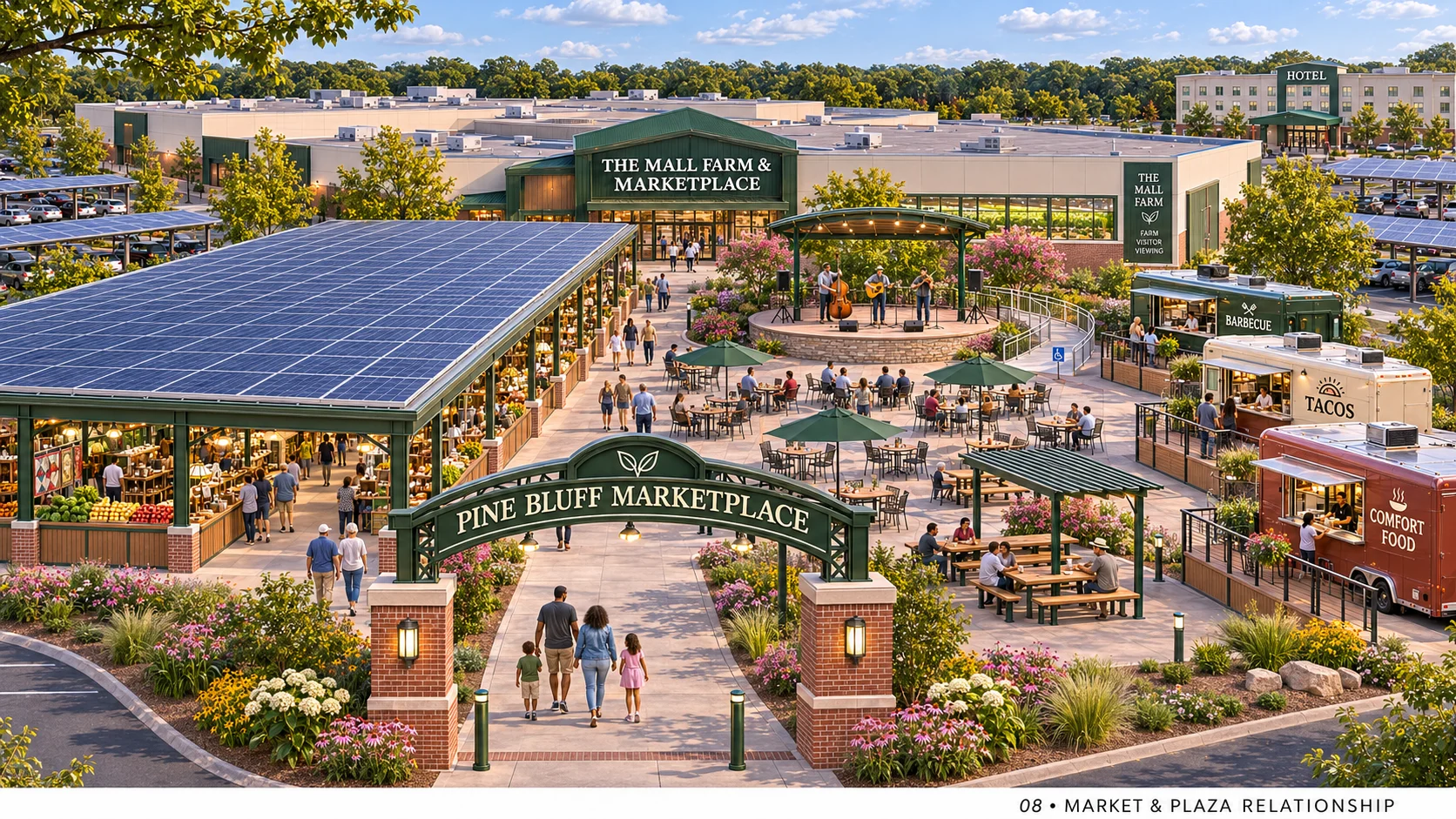
See what belongs hereExplore our prototype for future locations: a working farm, solar-covered marketplace, six wind turbines, food trucks, public art and welcoming outdoor spaces.
Explore the prototype PROTOTYPE FOR FUTURE LOCATIONS View the concept
Prototype concept featuring six wind turbines and solar canopies. Each site will adapt the design to its property, community and development requirements.
Both methods grow plants without soil. The difference is where the plant nutrients come from—and whether fish are part of the system.
Growers add a measured blend of mineral nutrients to water that reaches the roots. Plants also need oxygen, light and carefully managed growing conditions.
Stacked growing levels can make productive use of indoor space. Leafy greens and herbs are common crops; system and crop choices depend on the farm.
Aquaponics combines fish production with hydroponic growing. Beneficial bacteria transform fish waste into nutrients plants can absorb.
Plant uptake and filtration help condition water for reuse. The farm must balance fish health, plant needs and water quality; supplemental nutrients may still be needed.
Feed supplies inputs for the system.
Remove solids; bacteria convert waste nutrients.
Roots absorb available nutrients.
Return conditioned water to the fish system.
Educational illustration of a coupled system. Actual designs and operating requirements vary.
We envision using appropriate growing systems inside repurposed properties to connect fresh food production with local marketplaces, job training and hands-on education.
Each proposed location will evaluate hydroponics, aquaponics or separate fish production against its space, energy needs, operating expertise and customer demand.
Explore our growing guideLearn more: Virginia Cooperative Extension, Virginia Tech and Virginia State University — What is Controlled Environment Agriculture?, Mitchell Doss and coauthors. Educational reference; no affiliation or endorsement implied.