Industrial properties
Evaluate vacant plants and industrial facilities for controlled-environment agriculture, processing, distribution and other compatible operations.
Unlock the potential of distressed real estate through food production, local commerce and a long-term strategy for land and buildings—with community benefit at its core.
Our sustainable real estate investment approach evaluates vacant malls, offices, warehouses and industrial properties for indoor farming and marketplace uses. Property reuse, diversified income opportunities and community benefits guide the development thesis; returns remain project-specific targets.
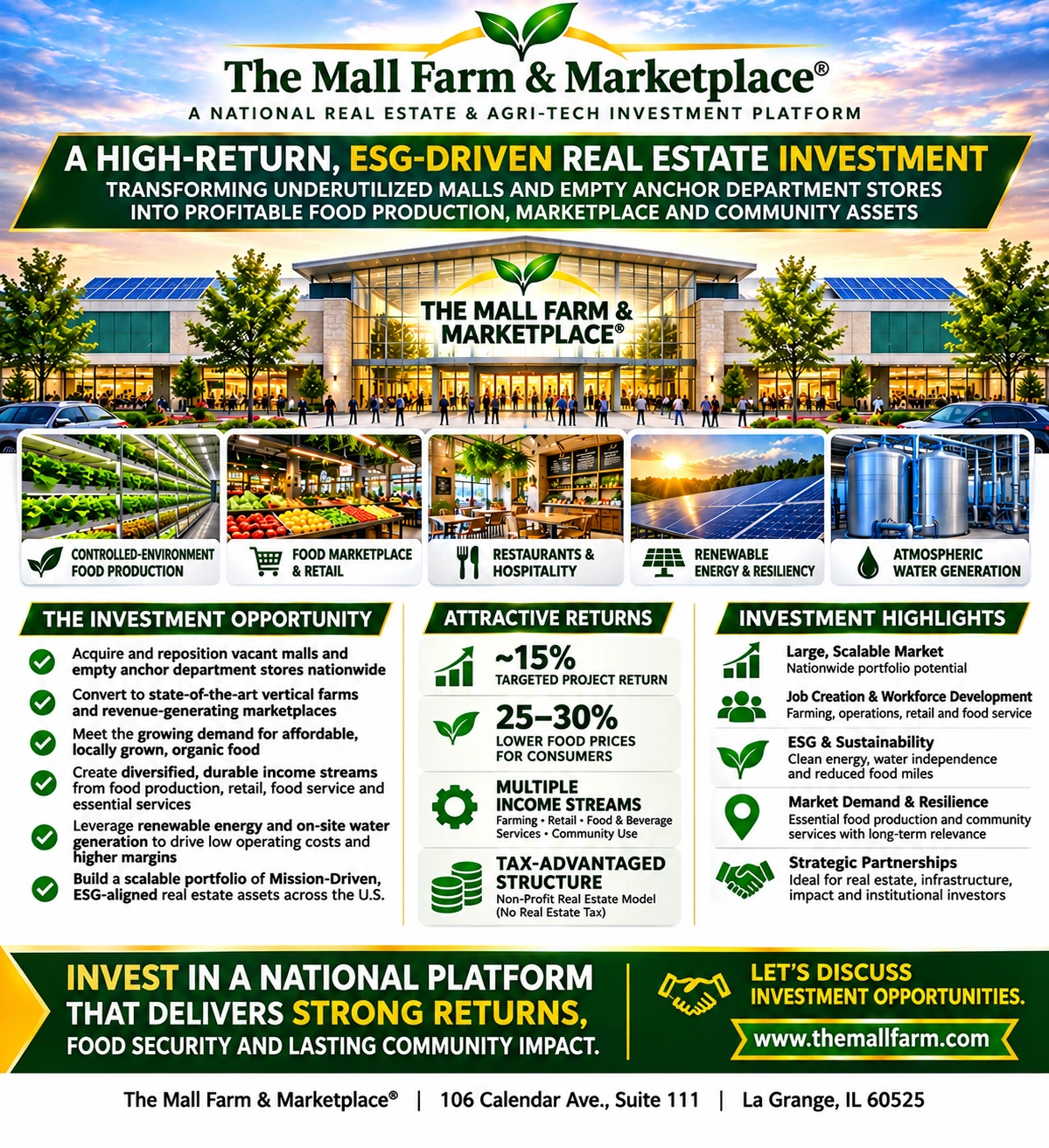
The Mall Farm investment vision · Select the poster to enlarge.
Our strategy seeks to acquire underused properties at a disciplined basis and reposition them for food production, marketplaces and compatible commercial uses. The goal is to build multiple income streams while delivering affordable, healthy food and next-generation jobs.
A sponsor objective, not historical performance, an industry ranking or a guaranteed investor return. Project materials must define the return measure, investment period, leverage, fees and distribution terms.
Discuss an investment opportunityWe welcome properties across asset types—not just vacant retail. The question is how each site can support a productive new use.
Evaluate vacant plants and industrial facilities for controlled-environment agriculture, processing, distribution and other compatible operations.
Assess large footprints, access, loading areas and utilities for growing systems, storage, packing and local food distribution.
Explore suitable office properties for agricultural, training, administrative or mixed-use conversion, based on the building’s layout and infrastructure.
Reposition established destinations with indoor farms, year-round marketplaces, food service and community uses.
Property fit depends on zoning, structural capacity, ceiling heights, power, water, HVAC, access, conversion costs and local demand. Not every distressed property will support the same program.
Our vision is to make the Mall Farm model a compelling way to bank land or buildings: preserve long-term options while exploring income-producing uses during the holding period.
Evaluate distressed pricing alongside carrying costs, environmental conditions, infrastructure and the full cost of bringing the property into productive use.
Where viable, phase in agriculture, tenant space or marketplace activity to pursue operating income and help offset holding expenses.
Structure improvements and partnerships around a long-term plan, with potential paths to continued operation, leasing, refinancing, redevelopment or sale.
Holding-period income, appreciation and carrying-cost coverage depend on each property and are not assured.
Controlled growing environments and crop plans designed for customer demand, reliable output and year-round production.
Retail, restaurants, food service and compatible hospitality uses evaluated as complementary income opportunities.
Evaluate renewable energy, storage and on-site water generation against engineering requirements and operating economics.
The sponsor’s goal is food pricing 25–30% below comparison prices, subject to crop costs, distribution and local market conditions.
Create opportunities in farming, technology, operations and local enterprise alongside training and community services.
Bring real estate, infrastructure, technology and impact partners together around clearly defined project responsibilities and terms.
Poster figures and benefits describe sponsor goals. Organic certification and any tax advantages require separate qualification; nonprofit ownership does not establish automatic property-tax exemption for every property or use.

Suitable retail, industrial, office and warehouse properties can offer opportunities for adaptive reuse. Our model evaluates how these places can support indoor agriculture, a marketplace and complementary community uses.
Discuss a projectEach project needs its own feasibility study, operating plan and financing structure. These are the proposed economic drivers.
Produce sales through retail, foodservice and wholesale channels, with crop selection and buyer demand evaluated together.
Stall and tenant income from local food, products and services; flexible participation helps businesses find the right entry point.
Site-specific food and beverage, gatherings and other compatible uses that bring people back throughout the week.
A credible investment story connects the property, growing operation and customers. We welcome partners who help test and strengthen each part.
Acquisition basis, title, zoning, building condition, structural loads, access and conversion requirements.
Equipment, electricity, HVAC, water, labor, maintenance, crop yields and realistic production ramp-up.
Produce pricing, customer channels, offtake opportunities, marketplace demand and nearby competition.
Sources and uses, reserves, ownership and operating entities, reporting, repayment and exit assumptions.
The nonprofit mission and any private investment must be reflected in properly documented entity and transaction structures. Project materials should establish the specific terms.
Discuss project-level financing and investment participation.
Start an investor discussionSubmit vacant malls, anchor stores, industrial buildings, offices, warehouses or land for consideration.
Introduce a propertyExplore agriculture, energy, construction, distribution and marketplace opportunities.
Explore a partnershipThis website introduces a development concept. It is not an offering of securities or a promise of investment performance. Project-specific materials, agreements and diligence govern any participation.